Was Portugal a constitutional monarchy? Yes, until 1910
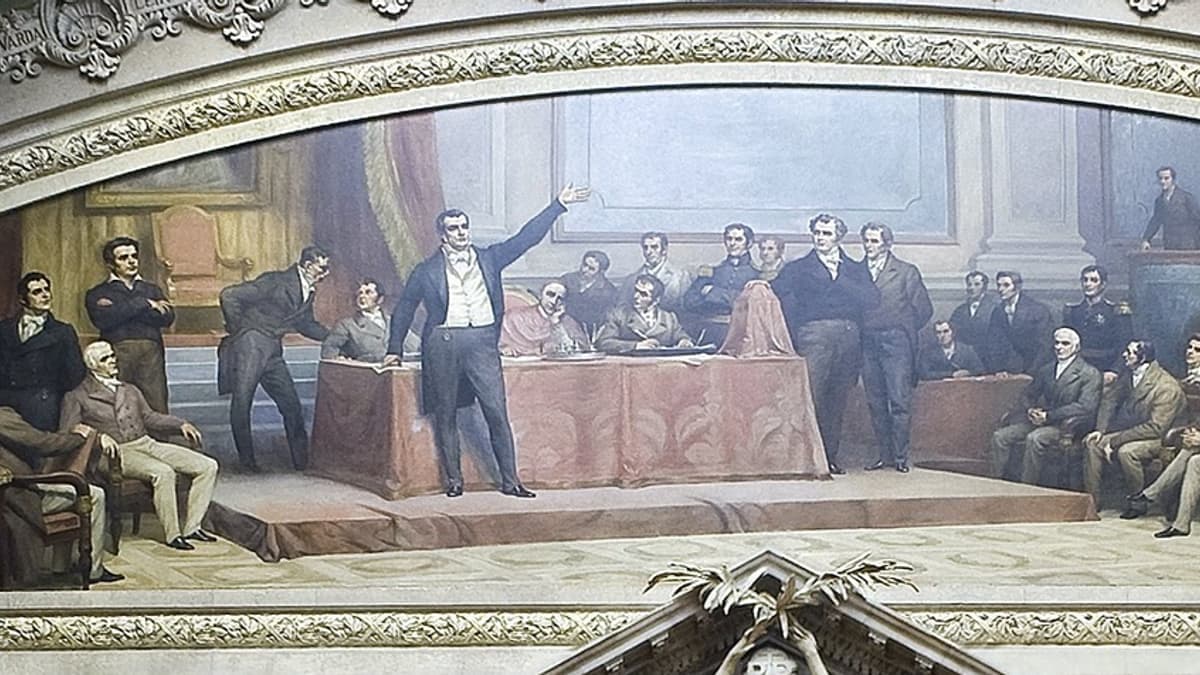
Yes. Portugal was a constitutional monarchy, briefly from 1822 and then without a break from 1834 to 1910, when a revolution made it the republic it is today. There has been no king since. Between those dates sits a story most newcomers never hear: a liberal uprising, a constitution written by elected deputies, and a civil war between two royal brothers.
If you are preparing for the citizenship test, you have probably read about the Constitution of 1976 and stopped there. The law asks for Portuguese «history» without listing episodes, and our main guide to Portuguese history explains how to study a subject with no closed list. This page covers the part of the nineteenth century that is easy to miss, and it comes down to a handful of dates.
- 24 August 1820: a liberal uprising in Porto. 23 September 1822: Portugal's first constitution.
- 29 April 1826: King Pedro IV grants a Constitutional Charter, signed in Rio de Janeiro.
- 1832–1834: civil war. Pedro leads the liberals, his brother Miguel the absolutists. It ends at Évora-Monte on 26 May 1834.
- 5 October 1910: the monarchy falls.
What does «constitutional monarchy» mean here?
It means a king whose powers are written down and limited, sharing them with an elected parliament. Before 1820, the Portuguese king ruled as an absolute monarch. In that year the royal court was not even in the country. It had left for Rio de Janeiro when Napoleon's armies invaded, and it stayed there long after the fighting ended.
On 24 August 1820, army officers in Porto rose up and called for an elected assembly to write a constitution. Portuguese history calls that assembly the Cortes, an old word for the kingdom's parliament, and you will meet it in almost everything written on this period. Elections were finished by Christmas Day 1820. The new parliament opened in January 1821 and ordered King João VI home from Brazil to swear to the principles of the coming text.
What was in Portugal's first constitution?
The Cortes approved it in Lisbon on 23 September 1822, and the king swore to it on 1 October. Its central idea is that the country does not belong to the king. The wording, in the spelling of the time, is still striking:
«A Nação é livre e independente, e não pode ser patrimonio de ninguem. A ella sómente pertence fazer pelos seus Deputados juntos em Cortes a sua Constituição, ou Lei Fundamental, sem dependencia de sancção do Rei.»
In plain English: the nation is free, it is nobody's property, and only its deputies can give it a constitution, with no need for the king's approval. The rest follows from there. There were three separate powers and a single elected chamber. The king could send a law back once, but he could not dissolve parliament. It was not democracy as we would know it: women and most people under 25 could not vote.
It did not last. In May 1823 the king's younger son, Miguel, led a military revolt known as the Vilafrancada, and by 3 June the constitution was gone.
Did the 1822 constitution already cover naturalisation?
It did, which should interest anyone reading this with an application in progress. The text lists who counts as a Portuguese citizen, and that list includes foreigners who obtain a «carta de naturalisação», a letter of naturalisation. An adult foreigner living in the kingdom could get one by meeting any one of a few conditions: marrying a Portuguese woman, owning property or a business there, carrying on a useful trade, or having done the nation «serviços relevantes», notable service. It says nothing about language or an exam.
It also said that a citizen who naturalised in another country stopped being Portuguese. That is no longer how it works. Today losing Portuguese nationality generally takes a declaration by someone who holds another nationality and does not want to remain Portuguese. Nobody needs this for a test, but it makes a date easier to remember.
Why did two brothers go to war?
When João VI died in 1826, his heir was his elder son, Pedro. There was an awkward detail: Pedro had declared Brazil independent in 1822 and was its emperor. So he is the same man under two numbers, Pedro IV in Portugal and Pedro I in Brazil. He stayed in Rio, and from there he gave Portugal a new text, the Constitutional Charter, dated 29 April 1826. Then he gave up the Portuguese crown in favour of his young daughter, Maria.
The Charter was a very different thing from the 1822 constitution. It came from the king as a gift rather than from elected deputies, and the verb used in Portuguese, outorgar (to grant), is the word to know. It added a fourth power for the king, the «poder moderador», and a second chamber of peers he appointed himself.
In February 1828 Miguel came back from exile as regent, promising to respect the Charter. In May he had himself acclaimed absolute king. Liberals fled, and many held out on Terceira, in the Azores. Pedro abdicated in Brazil in 1831, sailed for Europe, and led an expedition against his brother.
- 8 Jul 1832The liberal force lands at Mindelo, north of Porto, and takes the city without a fight.
- 1832–1833The siege of Porto: a year with neither side gaining the upper hand.
- 16 May 1834The Battle of Asseiceira, Miguel's last major defeat.
- 26 May 1834Miguel surrenders at Évora-Monte and goes into exile.
- 24 Sep 1834Pedro dies at Queluz, aged 35. His heart is kept in the Lapa Church in Porto.
You will see this war dated two ways. «1832–1834» counts the fighting between the two armies and is the usual form in Portugal. English sources often call the whole affair the Liberal Wars and start in 1828, when Miguel took the throne. Either way, it ended in 1834.
Why does this matter if you come from Brazil?
Because you already know the main character. The man Brazilian schoolbooks place at Ipiranga, the first emperor, is the same man who led the Portuguese liberals. His story did not stop when he abdicated in 1831. It carried on across the Atlantic and finished in Portugal.
The two countries overlap in the 1822 text as well. It was approved sixteen days after 7 September, and it still described a nation spread across «ambos os hemisferios», both hemispheres. Pedro's remains were taken to Brazil in 1972 for the 150th anniversary of independence. His heart stayed in Porto, leaving only in 2022 for a visit to Brasília during the bicentenary.
One more detail that trips people up: the flag of these years is the blue and white one of the monarchy. The green and red flag came with the Republic.
How long did the monarchy last after that?
Another 76 years, and the first twenty were rough. The winners split between supporters of the 1822 text and supporters of the Charter, and each side took turns overthrowing the other.
| Year | Event | What it did |
|---|---|---|
| 1836 | September Revolution | Brought back the 1822 text, then produced a compromise constitution in 1838 |
| 1842 | Costa Cabral's coup | Restored the Charter, which stayed until 1910 |
| 1846–1847 | Maria da Fonte and Patuleia | Popular revolt in the north, then a civil conflict ended by the Convention of Gramido |
| 1851 | Regeneração | Marshal Saldanha's revolt removed Costa Cabral; direct election of deputies followed in 1852 |
After that came a calmer period in which two parties took turns in government. Then, on 11 January 1890, Britain issued an ultimatum ordering Portugal to give up its claim to the African land between Angola and Mozambique. The national humiliation fell on the crown. A republican revolt in Porto on 31 January 1891 was crushed the same day, but the idea did not go away.
From here the story belongs to other pages: the national anthem was born out of that ultimatum, the king was assassinated in 1908, and the Republic arrived in 1910.
What should you actually memorise?
Fair questions on this period have one clear answer and do not depend on interpretation. These are worth having straight:
- the first Portuguese constitution: 1822 (the revolution was 1820);
- the Charter: 1826, granted by the king rather than voted;
- the two sides of the civil war: Pedro for the liberals, Miguel for the absolutists;
- the year the war ended: 1834;
- the end of the monarchy: 1910, not the assassination of 1908.
Skip the minor generals and the details of each coup. Portugal has had six constitutional texts in all, and the one in force is the Constitution of 1976. That is the one to know in depth, while 1822 is the one to recognise when the question says «first».
Where to go from here
The history flashcards are free and help you put these dates in order. Once they feel settled, the free practice quiz takes a few minutes and shows whether history is still where you lose points or whether your time is better spent on another subject.
Sources
- Constituição Política da Monarquia Portuguesa de 1822, artigos 20.º a 23.º, 27.º, 29.º, 30.º e 110.º
- Carta Constitucional de 29 de abril de 1826, artigos 5.º, 11.º, 14.º e 71.º
- Assembleia da República, «A Monarquia Constitucional (1820-1910)»
- Assembleia da República, Arquivo Histórico Parlamentar, «História» (Convenção de Évora-Monte)
- Lei da Nacionalidade (Lei n.º 37/81), artigo 6.º, n.º 1, alínea c), e artigo 8.º