Estado Novo Portugal: dates from 1910 to 1974
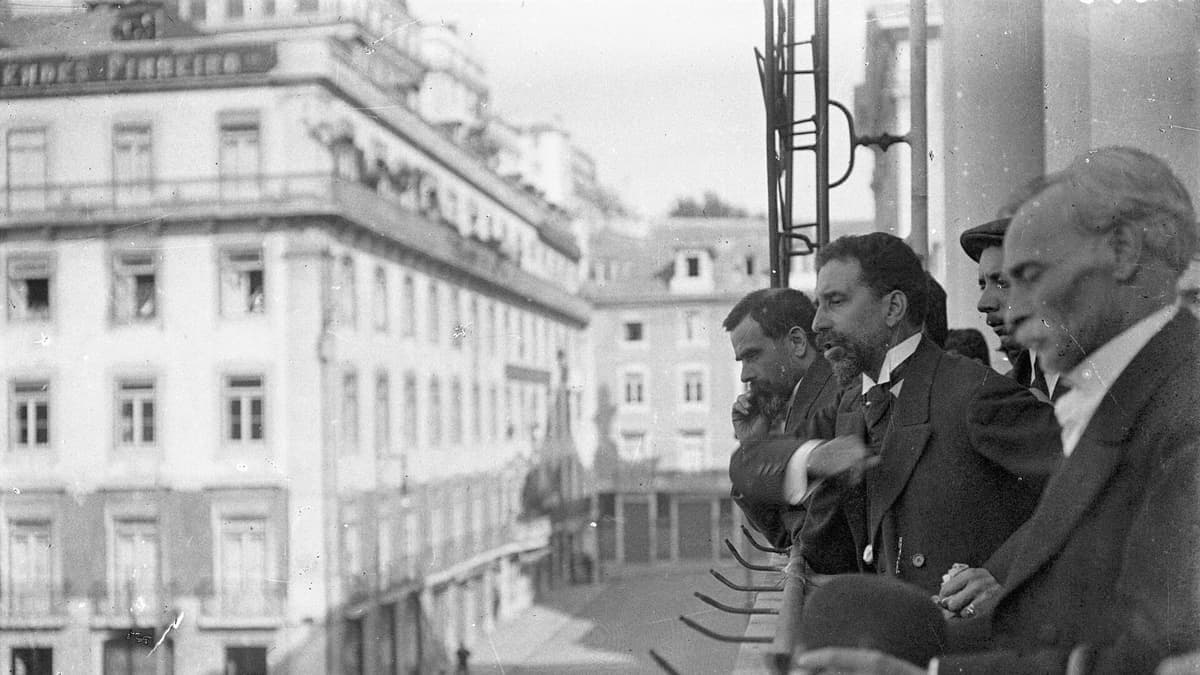
Portugal's twentieth century before democracy has two chapters. The First Republic ran from the revolution of 5 October 1910, which ended the monarchy, to a military coup on 28 May 1926. The dictatorship that followed was given a constitution in 1933 and called itself the Estado Novo, the «New State». António de Oliveira Salazar led it until 1968 and Marcelo Caetano until it was overthrown on 25 April 1974.
If you learned European history elsewhere, this period is easy to blur: Spain, Italy and Germany all had dictatorships in the same decades, and Portugal's outlasted every other one in Western Europe. Our guide to Portuguese history for the citizenship test gives the two dates the Constitution itself names, 1910 and 1974. This page covers the sixty-four years between them, with the dates a fair question could ask about.
- 1910: revolution, the monarchy ends and Portugal becomes a republic.
- 1926: a military coup ends the First Republic. This is the date people mistake for 1910.
- 1933: a new constitution, approved by plebiscite, creates the Estado Novo.
- Salazar governs until 1968, Caetano until 1974. The colonial war runs from 1961 to 1974.
- 19105 October: revolution in Lisbon; the Republic is proclaimed.
- 191121 August: the first republican constitution. The green-and-red flag dates from the same year.
- 192628 May: military coup launched from Braga. Military dictatorship.
- 1932Salazar, finance minister since 1928, becomes head of government.
- 1933New constitution approved by plebiscite on 19 March, in force from 11 April: the Estado Novo.
- 1961War breaks out in Angola, then spreads to Guinea and Mozambique.
- 1968Salazar is incapacitated; Marcelo Caetano replaces him.
- 197425 April: the Armed Forces Movement overthrows the regime.
When did Portugal become a republic: 1910 or 1926?
1910. On our practice quiz, 44% of people get «In what year was the Republic established?» wrong, and the most popular wrong answer is 1926. Both years mark a change of regime, which is why they get mixed up, but they point in opposite directions. 1910 ends the monarchy. 1926 ends the parliamentary republic that replaced it.
You can see 1910 in daily life. The current Constitution defines the national flag as the one adopted by the Republic «established by the Revolution of 5 October 1910», and 5 October is a national public holiday under the Labour Code. It was one of four holidays suspended during the austerity years of 2013–2015 and restored in 2016.
What was the First Republic?
Sixteen years of parliamentary government, and famously unstable ones. After the revolution, a constituent assembly adopted the first republican constitution on 21 August 1911, which opens by declaring that the Portuguese nation «adopts the Republic as its form of government». Manuel de Arriaga became the first elected President the same year.
What followed was a long run of short-lived governments, presidents who did not finish their terms, and coups. In 1916 Portugal entered the First World War on the Allied side and sent troops to Flanders and Africa. For the test, the frame matters more than the detail: it started in 1910, it ended in 1926, and it was Portugal's first republic.
1926 to 1933: from a coup to a regime
The coup of 28 May 1926 began in the northern city of Braga and brought the army to power within days. Seven years of military dictatorship followed. In 1928 a Coimbra economics professor, António de Oliveira Salazar, became finance minister, and from that post he became the dominant figure in government. In 1932 he became its head.
Four dates in seven years — 1926, 1928, 1932, 1933 — and a multiple choice question can use any of them as a distractor. The two worth holding on to are 1926, when the dictatorship began, and 1933, when it acquired a constitution and a name.
A simple way to keep them apart is to tie each date to a document or an event rather than to a person. 1926 is a coup, so it has no text of its own; 1933 is a constitution, voted on by plebiscite, so it is the year the regime wrote itself down. Salazar is the thread running through both, but his own dates — finance in 1928, head of government in 1932 — are the ones least likely to be asked and most likely to appear as wrong options. If you only learn two numbers from this section, learn 1926 and 1933, and remember that the first one is the answer to «when did the dictatorship begin?», never to «when did the Republic begin?».
Was the Estado Novo still a republic?
Yes, on paper. This surprises many newcomers: the dictatorship did not bring back the king. The 1933 Constitution, put to a plebiscite on 19 March and in force from 11 April 1933, described Portugal in its article 5 as «a unitary and corporative Republic». Corporative meant that society was meant to be represented through professional and economic bodies rather than political parties.
In practice there was a single party, the National Union, prior censorship of the press, and a political police known first as the PVDE and later as the PIDE. Portugal kept a President of the Republic throughout, but real power lay with the President of the Council — the prime minister — and that was Salazar for thirty-six years. The 1976 Constitution, still in force, describes the regime it replaced as a «fascist regime» in its preamble. That is the view the Portuguese state takes officially, and it is the one a Portuguese test can assume.
What else should you know about the Estado Novo?
Three facts cover most fair questions. Portugal stayed neutral in the Second World War. It was a founding member of NATO in 1949. And from 1961 it fought a colonial war in three African territories: Angola, Guinea and Mozambique. The war lasted until 1974, and many of the soldiers who ended the regime had served in it.
In 1968 Salazar was incapacitated after a fall and was replaced by Marcelo Caetano, who promised some opening but kept the war going. Salazar died in 1970. On 25 April 1974 the Armed Forces Movement overthrew Caetano's government, which led to free elections and the 1976 Constitution that Portugal still lives under.
What could a test reasonably ask about 1910–1974?
The content of the test has not been published, but some questions about this period are clearly fair, because each has one right answer and no room for opinion:
- the year the Republic was established (1910, not 1926);
- the year the First Republic fell to a coup (1926);
- the name of the regime created in 1933 (Estado Novo);
- who led it for most of its life (Salazar) and who followed (Caetano);
- when the colonial war began (1961) and when the regime fell (1974).
You can safely skip the First Republic's presidents, its count of governments and the details of each revolt. If you want to see why 1910 and 1926 trip people up, read the quiz questions people get wrong most often. Once this timeline feels easy, the free practice quiz will tell you whether history is still your weakest theme.
Sources
- Lei da Nacionalidade (Lei n.º 37/81), artigo 6.º, n.º 1, alínea c)
- Constituição Política da República Portuguesa de 21 de agosto de 1911, artigo 1.º
- Constituição Política da República Portuguesa de 1933, nota de publicação e artigo 5.º
- Constituição da República Portuguesa, preâmbulo
- Código do Trabalho (Lei n.º 7/2009), artigo 234.º (feriados obrigatórios)