Why the Portuguese court moved to Brazil, and what followed
The Portuguese court moved to Brazil to stay out of Napoleon's hands. On 29 November 1807, with a French army a day from Lisbon, the Prince Regent and his court sailed for the colony. Rio de Janeiro became the seat of the Portuguese crown until 1821 — and by 1822 Brazil was an independent country.
You may need this for the Portuguese citizenship test: the law lists "history" without saying which events, as our guide to the new Portuguese citizenship test explains. If you learned European history in English, you already know a piece of this as the Peninsular War and the Duke of Wellington. What you probably never heard is the Portuguese side: the same years, with different names and a king on the wrong continent.
- France invaded Portugal three times: under Junot (1807), Soult (1809) and Masséna (1810). All three failed.
- The court left Lisbon on 29 November 1807 and reached Rio on 7 March 1808.
- In 1815 Brazil was made a kingdom, equal in name to Portugal. King João VI went home only in 1821.
- His son Pedro stayed behind and declared Brazil independent on 7 September 1822. Portugal recognised it in 1825.
The Portuguese names you will meet
Questions will use Portuguese terms, and they do not all match the ones in English books. The Invasões Francesas are the three French invasions; together they fall inside what Portugal calls the Guerra Peninsular, the Peninsular War. The general is Massena, usually without the accent, and King John VI is D. João VI. Arthur Wellesley appears under both names, because he only became Wellington during the war. And the Linhas de Torres or Linhas de Torres Vedras are the Lines of Torres Vedras.
Why did the Portuguese court leave Lisbon?
Because Portugal had run out of ways to stay neutral. Napoleon's Continental System of 1806 tried to close Europe's ports to British trade, and Portugal was Britain's old ally and depended on that trade. In October 1807 France and Spain signed the Treaty of Fontainebleau, which planned to carve Portugal up and remove its royal house, and General Junot marched.
The man deciding was Prince João, regent for his ill mother, Queen Maria I. He had a way out: a huge colony across the ocean, and a British navy willing to help. The court boarded on 27 November; the wind held the ships in the Tagus until the 29th; Junot walked into Lisbon on the 30th. Portuguese writers still argue whether to call this a flight or a clever move, and you will see both fuga ("escape") and transferência ("transfer"). The dates are the same either way.
What did the three invasions look like?
| Year | French commander | What happened | How it ended |
|---|---|---|---|
| 1807–08 | Junot | Occupied Lisbon | Beaten by Wellesley at Vimeiro, August 1808; shipped home under the Convention of Sintra |
| 1809 | Soult | Came in from the north, took Porto on 29 March | Wellesley crossed the Douro and retook Porto on 12 May |
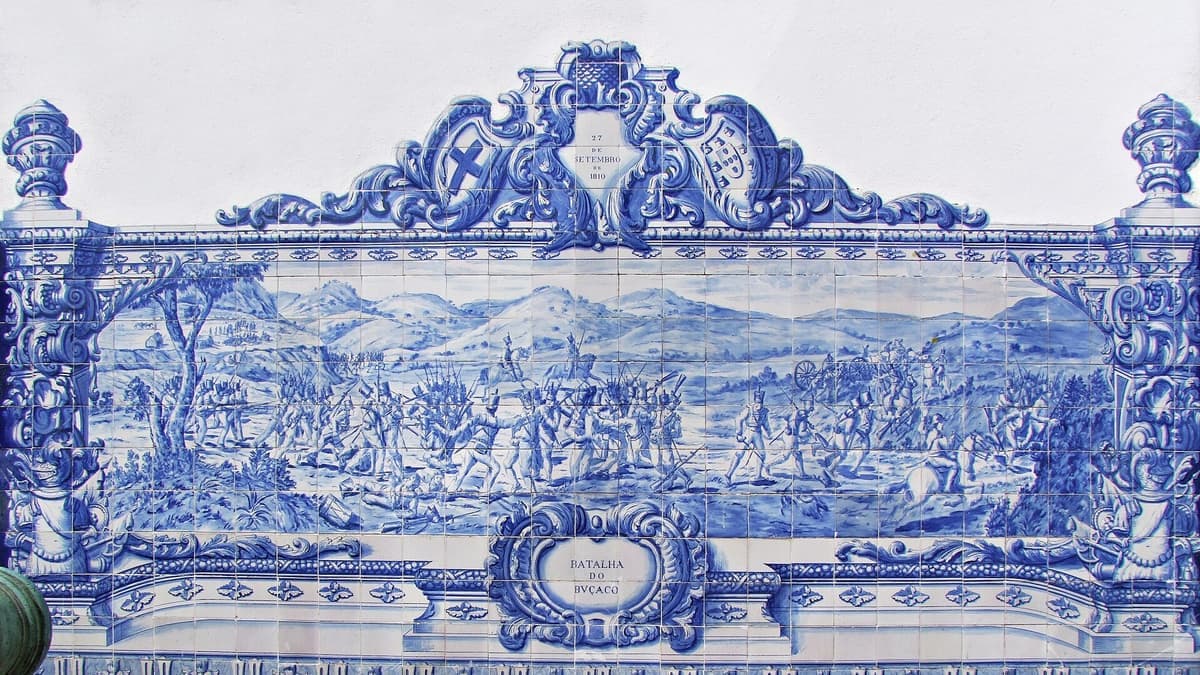
| 1810–11 | Masséna | Fought at Buçaco (27 September 1810), then marched on Lisbon | Stopped at the Lines of Torres Vedras; out of Portugal by spring 1811 |
If a question only gives you a name and asks for a number, that table is the whole answer: Junot first, Soult second, Masséna third.
Porto remembers the second invasion for a different reason. When the French stormed the city on 29 March 1809, crowds running for the south bank packed the Ponte das Barcas, a bridge of boats across the Douro, and it gave way. Many people drowned, and sources do not agree on how many. A small bronze shrine in the Ribeira district, right by the river, still marks the place.
What were the Lines of Torres Vedras?
A chain of forts north of Lisbon, built in secret on Wellington's orders between 1809 and 1810; two main lines faced the French. Masséna reached them in October 1810, with no idea they existed, and could not get through. The countryside in front of them had been stripped of food on purpose, and over the following months hunger did what a battle had not. It is one of the great defensive feats of the Napoleonic Wars, and Portugal listed the Lines as a National Monument (Monumento Nacional) in 2019. You can visit several of the forts on a day trip from Lisbon.
What happened to Brazil while the king was there?
It stopped behaving like a colony. On the way to Rio, the court stopped in Salvador, and on 28 January 1808 João opened Brazil's ports to ships from friendly nations; until then, its trade had to pass through Portugal. On 16 December 1815 he went further and raised Brazil to a kingdom, creating the United Kingdom of Portugal, Brazil and the Algarves. Queen Maria died in Rio in 1816, and João was acclaimed king there in 1818.
A court needs paperwork and money, so Rio changed quickly. The royal printing house and the Banco do Brasil both date from 1808, the year the court arrived. Seen from Rio, João looks like the man who set up a state; seen from Lisbon, the same king looks like an absentee. You may hear both views, and a fair question will not ask you to pick one.
Back in Europe, this looked very different. Portugal had been fought over for years, its king was an ocean away and a British marshal, William Beresford, ran its army. In 1820 a liberal revolution broke out in Porto, and the new parliament in Lisbon demanded the king's return.
How did Brazil become independent?
João sailed from Rio on 26 April 1821 and landed in Lisbon on 3 July, leaving his son Pedro in charge. Lisbon then ordered Pedro home too. He refused on 9 January 1822, a date Brazilians know as the Dia do Fico ("I'm staying" day), and on 7 September, by the Ipiranga stream in São Paulo, he declared independence. By December he had been crowned emperor.
Here is the detail that makes it memorable. On 1 October 1822, more than three weeks after Ipiranga, João VI swore to Portugal's first constitution in Lisbon, and that text still described a nation of Portuguese "of both hemispheres", with Brazil listed as part of its territory. News crossed the Atlantic slowly. Portugal finally recognised independence in a treaty signed in Rio on 29 August 1825, with Britain as go-between.
One practical point: 7 September is a public holiday in Brazil, not in Portugal. It is not on the list of mandatory holidays in the Portuguese labour code, so do not count it among the national dates you learn.
Common mix-ups
- "King João VI left in 1807." He was still Prince Regent. He only became king in 1816 and was acclaimed in 1818.
- "Masséna took Lisbon." That was Junot, in 1807. Masséna never got past the Lines.
- "The king of Portugal freed Brazil." It was his son, and the king was by then in Lisbon.
- Two Pedros. Pedro I of Brazil and Pedro IV of Portugal are one man. The story of how he held both crowns is in our guide to the dynasties of Portugal.
- "French invasions of Brazil." Brazilian textbooks use this for a different episode: French colonies at Guanabara Bay from 1555 and in Maranhão from 1612. For Portuguese history, the phrase means 1807 to 1811.
What is worth learning, and what can you skip?
A fair question on this period has one correct answer and needs no opinion. These are worth knowing cold:
- three invasions, and which general led which;
- where the court went in 1807, and when the king came back (1821);
- what the Lines of Torres Vedras were and who they stopped;
- who declared Brazil independent, and in what year;
- the name of the kingdom created in 1815.
Skip the battle maps, the number of forts, the British subordinate commanders. English-language books give Wellington most of the attention, but he is one name here among several. If you only have room for two dates, make them 1807 and 1822.
Where to go next
These years sit between the 1755 Lisbon earthquake and the fall of the monarchy. To see how they fit into the wider subject, read how to study Portuguese history for the test, and use the free history flashcards to fix the order of kings and dates.
Once the three generals are in place, the free practice quiz takes a few minutes and shows whether history is still where you lose points, or whether your time is better spent on another topic.
Sources
- Lei da Nacionalidade (Lei n.º 37/81), artigo 6.º, n.º 1, alínea c)
- Carta de Lei de 16 de dezembro de 1815 (eleva o Estado do Brasil a Reino), Câmara dos Deputados do Brasil
- Constituição Política da Monarquia Portuguesa de 1822, artigo 20
- Carta Constitucional de 1826, artigo 5.º
- Carta Régia de 28 de janeiro de 1808 (abertura dos portos), em «Memória da Exposição», Câmara dos Deputados do Brasil
- Código do Trabalho (Lei n.º 7/2009), artigo 234.º (feriados obrigatórios)
- Portaria n.º 308/2019, de 6 de maio (Linhas de Torres Vedras, Monumento Nacional pelo Decreto n.º 10/2019)