What happened on 25 April 1974 in Portugal
On 25 April 1974, a group of mid-ranking army officers calling themselves the Armed Forces Movement (MFA) brought down the Estado Novo, the dictatorship that had ruled Portugal since 1933. It took less than a day. The prime minister, Marcelo Caetano, surrendered in the late afternoon; crowds poured into the streets of Lisbon and put red carnations in the soldiers' rifles. That is why the world knows it as the Carnation Revolution.
If you grew up outside Portugal, the easiest way to place it is this: Western Europe's longest-lasting dictatorship ended not with a war or a death but with a radio song and a coup almost nobody fought against. Our guide to Portuguese history for the citizenship test explains why this is one of the two dates the Constitution itself names. This page explains the day and the two years that followed.
- 25 April 1974: the MFA overthrows the Estado Novo in one day.
- The go-signals were two songs on the radio; the second was «Grândola, Vila Morena».
- 25 April 1975: first free elections, for the assembly that wrote the Constitution.
- 25 April 1976: the current Constitution comes into force.
A little background helps. The Estado Novo was built by António de Oliveira Salazar in the early 1930s: one legal party, censorship of the press, a political police that arrested opponents, and elections whose results nobody doubted in advance. Salazar fell ill in 1968 and Caetano replaced him, promising some opening; very little came. By the early 1970s Portugal was the poorest country in Western Europe, hundreds of thousands of people had emigrated, often illegally, to France and elsewhere, and young men were leaving to avoid the draft.
Why did the army turn against the regime?
Because of Africa. From 1961 Portugal had been fighting colonial wars in Angola, Guinea and Mozambique at the same time, with conscripts serving years-long tours. By 1973 a movement of captains — the people actually leading those soldiers — had concluded that the war could not be won and that the regime would not end it. Their programme was often summed up in three words: democratise, decolonise, develop.
How did a song start a revolution?
The plotters needed every unit to move at once without using telephones the political police could tap. So they used the radio.
- Just before 11 p.m. on 24 April, a Lisbon station played «E Depois do Adeus», Portugal's Eurovision song of that month. It meant: get ready.
- Just after midnight, Rádio Renascença played «Grândola, Vila Morena» by José «Zeca» Afonso, a folk singer the censors disliked. It meant: go.
By dawn, troops held the radio and television stations, the airport and the main government square in Lisbon. The best-remembered column came from the cavalry school at Santarém under Captain Fernando Salgueiro Maia, who surrounded the barracks in Largo do Carmo where Caetano had taken refuge. Caetano handed power to General António de Spínola, who then headed a military «National Salvation Junta».
It was nearly bloodless, not entirely: the only deadly shots of the day came from the headquarters of the political police, the PIDE/DGS, which fired on the crowd outside.
What changed in the weeks that followed?
Almost everything that defined the old regime went within days. Political prisoners walked out of the Caxias and Peniche jails. Prior censorship of the press ended. The PIDE/DGS was dissolved. Caetano and the President of the Republic, Admiral Américo Tomás, were flown into exile. Opposition leaders who had lived abroad for years came home, and parties that had existed only underground began to organise in the open.
A week after the coup, on 1 May 1974, Lisbon held its first free Labour Day in nearly half a century, and the crowds were enormous. What followed was not calm: two years of provisional governments, strikes, nationalisations and real fights over which way the country would go. You do not need the detail of that period for the test. You need its endpoints — a dictatorship falls in 1974, a democratic Constitution takes over in 1976 — because everything in the «organisation of the State» part of the syllabus starts from there.
Why carnations?
Simply because it was April and carnations were in season in Lisbon's flower stalls. People handed them to the soldiers, the soldiers pushed them into their gun barrels, and the photographs went around the world. The red carnation is still the emblem of the day; you will see it on lapels every 25 April, which is a public holiday in Portugal, commonly called Freedom Day.
How does the Constitution remember it?
Unusually, the Portuguese Constitution opens with a historical event rather than a principle. Its preamble begins:
A 25 de Abril de 1974, o Movimento das Forças Armadas, coroando a longa resistência do povo português e interpretando os seus sentimentos profundos, derrubou o regime fascista.
In English: on 25 April 1974 the Armed Forces Movement, «crowning the long resistance of the Portuguese people», overthrew the fascist regime. The next sentence lists what that meant — freeing Portugal from «dictatorship, oppression and colonialism». If a test asks what the revolution ended, those three words are the safest answer, and they come straight from the founding text.
How is 25 April marked today?
It is one of Portugal's compulsory public holidays, listed in the Labour Code, so shops and offices close as they would on Christmas. Parliament holds a formal session every year, and in Lisbon a march goes down the Avenida da Liberdade with carnations in hand. If you live in Portugal you will notice the date whether or not you study for it — which is one reason a test about life in the country is likely to ask about it.
Three different 25 Aprils — which is which?
This is where people lose marks. Portugal deliberately reused the date twice:
- 25 April 1974The revolution.
- July 1974A constitutional law recognises the colonies' right to self-determination and independence.
- 25 April 1975First free elections with universal suffrage, for the Constituent Assembly. Turnout was over 90 %.
- 2 April 1976The Constituent Assembly approves the Constitution — its official date.
- 25 April 1976The Constitution comes into force.
The rule of thumb: 1974 revolution, 1975 election, 1976 Constitution. The Constitution is dated 2 April 1976, the day it was approved; 25 April 1976 is only the day it took effect. Our page on the 1976 Constitution covers why 1974 is the most common wrong answer to «when was it approved».
Why does it matter if you were born in a former colony?
Within eighteen months of the revolution, Guinea-Bissau, Mozambique, Cape Verde, São Tomé and Príncipe and Angola were independent — Angola last, on 11 November 1975. Hundreds of thousands of people moved to Portugal in those months. In 1975 Portugal also had to decide who stayed Portuguese, and that decision still shapes nationality files today. If it concerns you or your parents, read who kept Portuguese nationality in 1975.
What should you actually know for the test?
The nationality law asks applicants to know Portuguese history and national symbols, and 25 April is the rare date whose answer is written into an official text. A fair question will have one right answer, such as:
- what happened on 25 April 1974 (the end of the Estado Novo);
- who did it (the MFA — not the PIDE, which was the regime's political police);
- which song was the signal («Grândola, Vila Morena»);
- why it is called the Carnation Revolution;
- what 25 April 1975 and 25 April 1976 were.
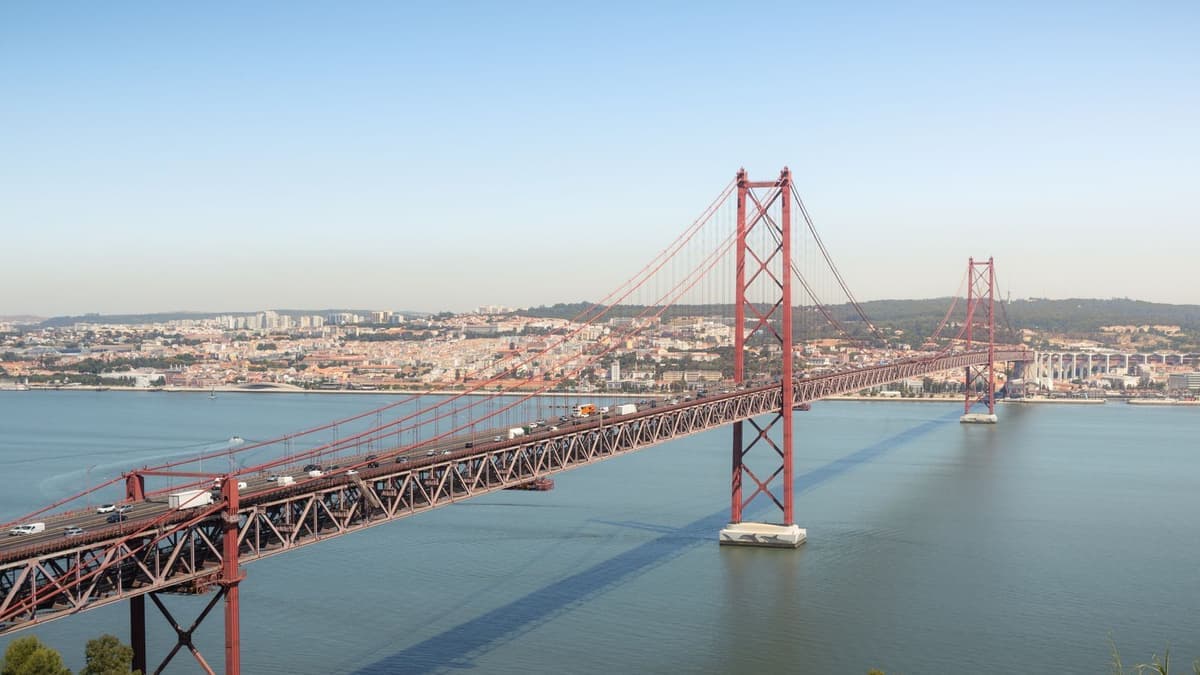
Skip the names of every officer and the minute-by-minute timetable. One local detail is worth knowing anyway: the red suspension bridge over the Tagus in Lisbon was opened as the Salazar Bridge and has been the 25 de Abril Bridge ever since the revolution.
Once you can rebuild the timeline above from memory, try the free practice quiz to see whether history is still your weakest area, or whether your study time is better spent on another of the citizenship test topics.
Sources