The 1755 Lisbon earthquake: the facts to know
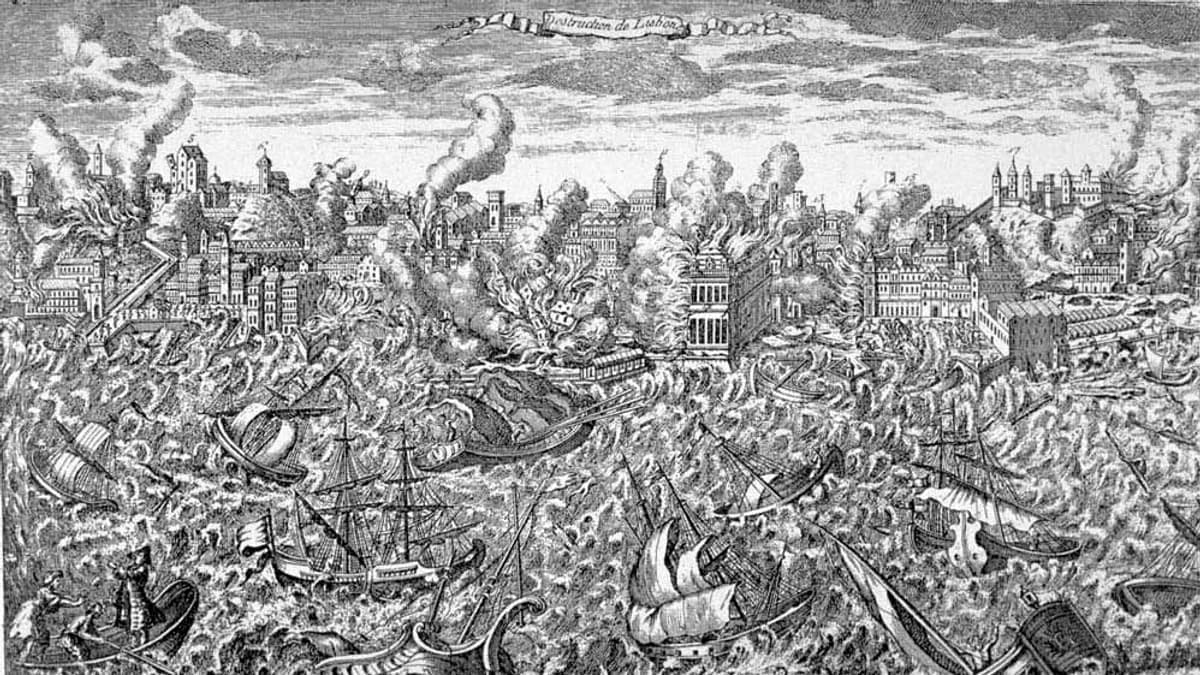
On the morning of 1 November 1755 — All Saints' Day — a massive earthquake struck Lisbon. Within hours a tsunami surged up the river Tagus, and fires burned the city for days. The king was José I; the man who ran the recovery was his minister, Sebastião José de Carvalho e Melo, known to history by the title he got later: the Marquis of Pombal. The grid of straight streets you walk through in downtown Lisbon today, the Baixa, is the city he had rebuilt.
If you are preparing for the Portuguese citizenship test, the law lists "history" as one of the subjects without saying which events count — the general picture is in our guide to the new Portuguese citizenship test. The earthquake is a safe bet to know: it is the one event in Portuguese history most people abroad have heard of, and it explains things you see every day if you live in Lisbon.
- When: the morning of 1 November 1755. Three disasters in a row — earthquake, tsunami, fire.
- Who ruled: King José I, of the House of Braganza. Who acted: his minister Carvalho e Melo, made Count of Oeiras in 1759 and Marquis of Pombal in 1769.
- What came out of it: the Pombaline Baixa — a planned grid, identical buildings and an early earthquake-resistant wooden frame.
- 1 November is a public holiday in Portugal because it is All Saints' Day, not because of the earthquake.
The Portuguese words you will meet
Questions will use Portuguese names, so learn these few first. Terramoto (or sismo) is the earthquake; maremoto or tsunami is the wave. The Baixa — literally "the low town" — is the flat downtown between Rossio square and the river. Pombalino means "of Pombal's time", so Baixa pombalina is the rebuilt downtown and a gaiola pombalina ("Pombaline cage") is its wooden frame. Praça do Comércio and Terreiro do Paço are two names for the same riverside square.
What happened in the 1755 Lisbon earthquake?
The shock came from under the Atlantic, off Portugal's southern coast. Seismologists today put its magnitude at roughly 8.5 to 9 — Portugal has felt nothing close to it since. Because it was a religious holiday, churches were full and lit with candles when the buildings came down.
Survivors who ran to open ground by the river were then caught by the tsunami, which also hit the Algarve and the coast of Morocco. Fallen candles and kitchen fires set the rubble alight, and the fire took days to burn out. Nobody counted the dead reliably: estimates run to tens of thousands and disagree widely. A test question is far more likely to ask about the date, the king or the rebuilding than about a number.
The royal palace on the river, the Paço da Ribeira, was lost with its library and archives. The royal family survived because they were staying in Belém, outside the centre. If you want to see the earthquake with your own eyes, go to the Carmo Convent in Chiado: its roofless Gothic arches have been left as they were.
Who was the Marquis of Pombal?
In 1755 he was not yet a marquis. Sebastião José de Carvalho e Melo was one of the king's ministers, and the disaster made him the most powerful man in the kingdom. He organised relief, held down food prices and put the state in charge of rebuilding. Tradition credits him with the line "bury the dead and care for the living" — it is probably not his, but it sums up his approach.
He became Count of Oeiras in 1759 and Marquis of Pombal in 1769, and it is the second title that stuck. His government also expelled the Jesuits from Portugal in 1759. He fell from power when José I died in 1777 and Queen Maria I came to the throne. His statue stands on the big roundabout at the top of Avenida da Liberdade, which everyone calls simply "Marquês". To place José I among the other kings, see the dynasties of Portugal.
Why does downtown Lisbon look the way it does?
Because it was designed from scratch. Instead of rebuilding the cramped medieval lanes, a team led by the chief engineer Manuel da Maia, with the architects Eugénio dos Santos and Carlos Mardel, drew a new plan. Four features are worth knowing:
- A grid. Straight, parallel streets from Rossio to the river, wide enough to get people out and slow a fire down.
- Standard buildings. The same façades and the same number of floors, so blocks could go up quickly, almost in series.
- The "cage". A timber frame of crossed braces built into the walls to hold the building together when the ground shakes — one of the first earthquake-minded building methods anywhere.
- A square open to the river. The Praça do Comércio took the place of the ruined palace. The rider in the middle is King José I, not Pombal.
Why did the earthquake shake Europe's thinkers?
A rich Catholic capital destroyed on a holy day was hard to square with the idea that everything happens for the best. Voltaire wrote his Poem on the Lisbon Disaster in 1756 and came back to Lisbon in Candide (1759). Rousseau wrote back to him, and Kant wrote about the natural causes of earthquakes. That is why 1755 turns up in European philosophy as well as in Portuguese history — and why, for many readers abroad, it is the first thing they ever learned about Portugal.
Does any of this still matter today?
Yes. The Lisbon region is still seismically active, and current Portuguese building rules reflect that: since 2019, larger works on an existing building — extensions, alterations, reconstructions above certain thresholds — require a report on how well it would stand up to an earthquake, and a strengthening project if it falls short of the standard. If you are renovating an old flat in Lisbon, this is 1755's long shadow on your paperwork.
The holiday is the other everyday trace. 1 November is one of Portugal's mandatory public holidays, but the labour code only names the date: it is All Saints' Day, a religious feast that is older than the earthquake.
Common mix-ups
The wrong answers that sound right: King João V (he died in 1750; José I was king in 1755); "the Marquis of Pombal in 1755" (he only got that title in 1769); the statue in the Praça do Comércio (it is the king, not Pombal); and the 1 November holiday (All Saints, not a day of remembrance for the earthquake).
Where to go next
The earthquake sits after the Age of Discovery and the Brazilian gold of the early 1700s, and before the French invasions and the end of the monarchy. Put José I and Pombal in that slot and most direct questions about 1755 answer themselves. The free history flashcards help with the order of the kings.
Once that is in place, the free practice quiz takes a few minutes and shows whether history is still where you lose points, or whether your time is better spent on another topic.
Sources