The Portuguese Age of Discovery: 7 dates to know
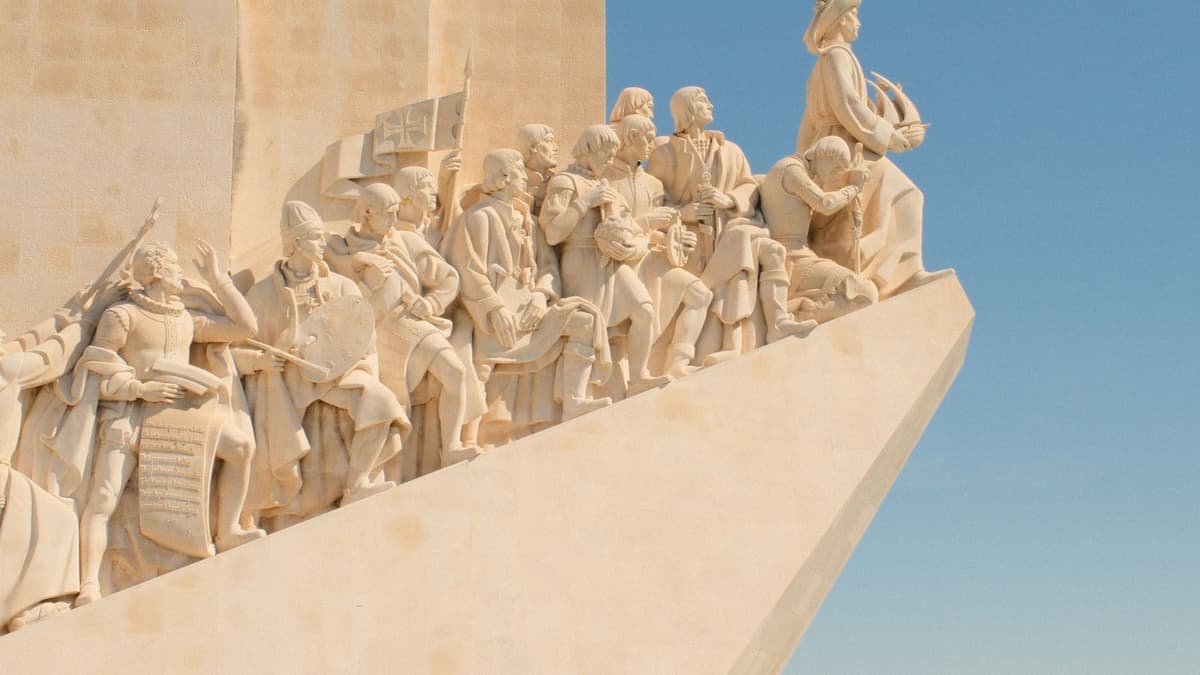
If you went to school outside Portugal, the Age of Discovery you learnt was probably Columbus in 1492. The Portuguese version starts earlier and has its own seven dates: Ceuta, 1415; Cape Bojador, 1434; the Cape of Good Hope, 1488; the Treaty of Tordesillas, 1494; Vasco da Gama reaching India in 1498; Pedro Álvares Cabral reaching Brazil in 1500; and Ferdinand Magellan's voyage round the world from 1519. Learn those in order, with the name attached to each, and you have the core of what a citizenship test can reasonably ask about the period.
The law lists «history» as a test subject without saying which history; the bigger picture is in our guide to the new Portuguese citizenship test. Our page on Portuguese history for the test explains how to study a topic with no official boundary. This page is the short list that comes after that advice.
- Seven dates: 1415, 1434, 1488, 1494, 1498, 1500, 1519. All fall under the Aviz dynasty.
- Vasco da Gama reached India; Cabral reached Brazil; Bartolomeu Dias rounded the Cape of Good Hope but never got to India.
- Magellan was Portuguese, but he sailed for the King of Spain.
- In Portuguese, most of these names look different: Henry the Navigator is «Infante D. Henrique», Magellan is «Fernão de Magalhães».
The names first: you will see them in Portuguese
A test written in Portugal will use Portuguese names, and some of them are hard to recognise from their English versions. Before any date, make sure you can match these:
| In English | In Portuguese | Known for |
|---|---|---|
| Henry the Navigator | Infante D. Henrique | Organising and funding the early African voyages |
| Gil Eanes | Gil Eanes | Rounding Cape Bojador, 1434 |
| Bartholomew Dias | Bartolomeu Dias | Rounding the Cape of Good Hope, 1488 |
| Vasco da Gama | Vasco da Gama | First sea voyage from Europe to India, 1498 |
| Pedro Álvares Cabral | Pedro Álvares Cabral | Reaching Brazil, 1500 |
| Ferdinand Magellan | Fernão de Magalhães | First voyage round the world, 1519–1522 |
One more name worth knowing: Luís de Camões, Portugal's national poet, whose epic Os Lusíadas (1572) tells the story of Vasco da Gama's voyage. You will meet him again on 10 June.
What happened in the Portuguese Age of Discovery, date by date?
Read the list as a single movement: down the coast of Africa, round its southern tip, then across the Indian Ocean. Each step only made sense once the one before it had worked.
- 1415Portugal captures Ceuta, on the North African coast, under King John I. Prince Henry takes part.
- 1434Gil Eanes sails past Cape Bojador, on the Atlantic coast of Africa — long treated as the edge of safe sailing.
- 1488Bartolomeu Dias rounds the southern tip of Africa, then called the Cape of Storms and later the Cape of Good Hope.
- 1494Treaty of Tordesillas: Portugal and Spain split the newly reached world between them.
- 1498Vasco da Gama reaches Calicut, on the west coast of India.
- 1500Pedro Álvares Cabral, on his way to India, reaches Brazil on 22 April.
- 1519–1522Magellan leads the first voyage round the world, for Spain; it is completed after his death.
Who was Henry the Navigator, and did he actually navigate?
Not in the sense of captaining ships. Prince Henry (Infante D. Henrique) was a son of King John I. He fought at Ceuta in 1415, and tradition credits him with organising and funding the first voyages down the African coast. The English nickname stuck, but in Portugal he is simply «o Infante».
He is not just a textbook figure. Portugal still awards the Order of Prince Henry (Ordem do Infante D. Henrique), one of the national orders set out in the 2011 law on honours. That makes him one of the safest names of the period to learn: the state keeps using it.
Why does Brazil speak Portuguese? The Treaty of Tordesillas
In 1492 Columbus reached the Americas for the Spanish crown, and Portugal and Spain needed a rule for who could claim what. On 7 June 1494, at Tordesillas, they agreed on a line running from pole to pole, 370 leagues west of the Cape Verde islands: the Portuguese side to the east, the Spanish side to the west.
The eastern bulge of South America fell on the Portuguese side. Six years later Cabral landed there, and that is why Brazil speaks Portuguese while the rest of South America mostly speaks Spanish. The treaty is on UNESCO's Memory of the World register; Portugal's copy is in the national archive in Lisbon, the Torre do Tombo.
Vasco da Gama or Cabral: who went where?
This is the pair most often swapped in multiple-choice questions, because the dates are two years apart.
- Vasco da Gama left Lisbon on 8 July 1497 and reached Calicut, India, in May 1498: the first sea route from Europe to Asia round Africa.
- Pedro Álvares Cabral left in March 1500, also bound for India, swung far west into the Atlantic and sighted Brazil on 22 April 1500. Then he carried on to India.
A memory hook: Gama, India, 1498 — the earlier date goes with the voyage that was planned; Cabral, Brazil, 1500 — the later one goes with the landfall on the way.
Was Magellan Portuguese?
Yes — and that is the trap. Fernão de Magalhães was Portuguese, but the voyage that made him famous sailed for the King of Spain. It left in 1519 to reach the Spice Islands by sailing west. Magellan was killed in the Philippines in 1521, and Juan Sebastián Elcano brought a single surviving ship home in 1522.
Portugal nonetheless counts the voyage as part of its history. In 2017 the government set up an official programme for the 500th anniversary, running from 2019 to 2022; the resolution that created it calls the voyage «the first complete voyage around the globe». So the answer to remember is: Portuguese navigator, Spanish fleet, first circumnavigation.
10 June: Portugal Day, and why Camões is in its name
10 June is a compulsory public holiday, and a 2016 decree-law gives it its official name: «Dia de Portugal, de Camões e das Comunidades Portuguesas» — Portugal Day, Camões Day and Portuguese Communities Day. The link to the poet of the Discoveries is real, but the reason for the date (traditionally, the day Camões died) is tradition: the decree sets the name and the date and does not say what is being commemorated. If a question asks for the day's official name, it is the long one above.
Where you can see this period in Lisbon
If you live in or near Lisbon, the period is easier to remember once you have walked through it. In Belém, by the river, two buildings from the reign of King Manuel I stand a few hundred metres apart: the Jerónimos Monastery and the Belém Tower. Together they have been a UNESCO World Heritage site since 1983, listed as a testimony to Portuguese culture of the 15th and 16th centuries. Vasco da Gama's tomb is in the Jerónimos church, and so is a tomb honouring Camões — a neat way to fix the link between the voyage and the poem.
You will also see the armillary sphere — the globe-like instrument on the Portuguese flag — carved all over these buildings. It was King Manuel I's personal emblem, and preparation materials often give «the Discoveries» as the answer to «what does the sphere on the flag stand for?». The flag's design comes from decrees of 1911; how each element is read is history rather than statute, and our page on Portugal's national symbols keeps the two apart.
What does a fair test question on the Discoveries look like?
Nobody can tell you today which history questions the test will use. What can be said is which questions about this period are fair, because each has one right answer that does not depend on opinion:
- who reached India by sea in 1498 (Vasco da Gama);
- who reached Brazil in 1500 (Pedro Álvares Cabral);
- which treaty divided the world between Portugal and Spain (Tordesillas, 1494);
- which cape Bartolomeu Dias rounded (the Cape of Good Hope);
- the full official name of the 10 June holiday.
Watch the distractors as well as the answers. A treaty question about 1143 — when Portugal was recognised as a kingdom — may list Tordesillas among the options precisely because it sounds familiar; Tordesillas is 350 years later and about the sea, not independence.
What you can safely skip
Ship names, the size of each fleet, every port of call, the exact day of each event other than the ones above. Debates about how to judge the empire are a serious subject, but they are not what a test with one right answer per question can ask; stick to facts and dates. The longer argument for studying this way is on the history overview page.
Where to go next
All seven dates sit inside one royal house, the Aviz dynasty, which ends in 1580. The page on Portugal's royal dynasties picks up the story there, and our history flashcards cover 10 June and the other dates Portuguese law names.
Once you can say the seven dates in order, with a name for each, try the free practice quiz: it shows in a few minutes whether history is still where you lose points, or whether your time is better spent on another theme.
Sources
- Lei da Nacionalidade (Lei n.º 37/81), artigo 6.º, n.º 1, alínea c)
- Resolução do Conselho de Ministros n.º 24/2017, de 26 de janeiro (V Centenário da circum-navegação de Fernão de Magalhães)
- Decreto-Lei n.º 20-A/2016, de 27 de abril (Dia de Portugal, de Camões e das Comunidades Portuguesas)
- Código do Trabalho (Lei n.º 7/2009), artigo 234.º (feriados obrigatórios)
- Lei n.º 5/2011, de 2 de março (Ordens Honoríficas Portuguesas)